Reflections on a recent visit to the People’s Republic of China.
6,674 words, 35 minutes read time.
Introduction

I’ve recently returned from an eighteen-day family visit to China, and I thought it might be interesting to try and formulate some of the political thoughts and observations I jotted down in the daily journal I kept during the visit.
For those who don’t know me, my wife is Chinese and our two sons, aged sixteen and twelve, are of mixed race. We married in China in 2007 and honeymooned in Beijing during my second visit to the country. I also visited in 2009, when we introduced our baby first-born to the Chinese side of his family for the first time, and in 2013 when we did the same with our second child. This year’s visit was my first in eleven years, though my wife and children have been in the interim.
This trip was therefore primarily a chance to connect again with family, particularly for my wife to see her mother whilst she still can, and ditto our boys their grandmother, their last surviving grandparent.
We spent three days in Foshan, a beautiful city about an hour by inexpensive taxi from Guangzhou, the home of a particular aunt and cousin, five days in Guangzhou itself, the more touristy aspect of the visit, and our remaining time in Wuzhou, my wife’s home city, where the vast bulk of her family still lives.
I make no claim that this will be anything other than a purely subjective, impressionistic account. Though I am a political animal, I’m not a political theorist and possess no great expertise in political economy.
What I believe makes my observations of potential interest and validity is that my family connections allow me to experience life amongst ordinary Chinese people in a manner that is perhaps not available to the average tourist.
Wuzhou is roughly the size of Liverpool, my home city in England, though with double the population. It is now an hour away by high-speed train from Guangzhou, a link that didn’t exist on my previous visits.
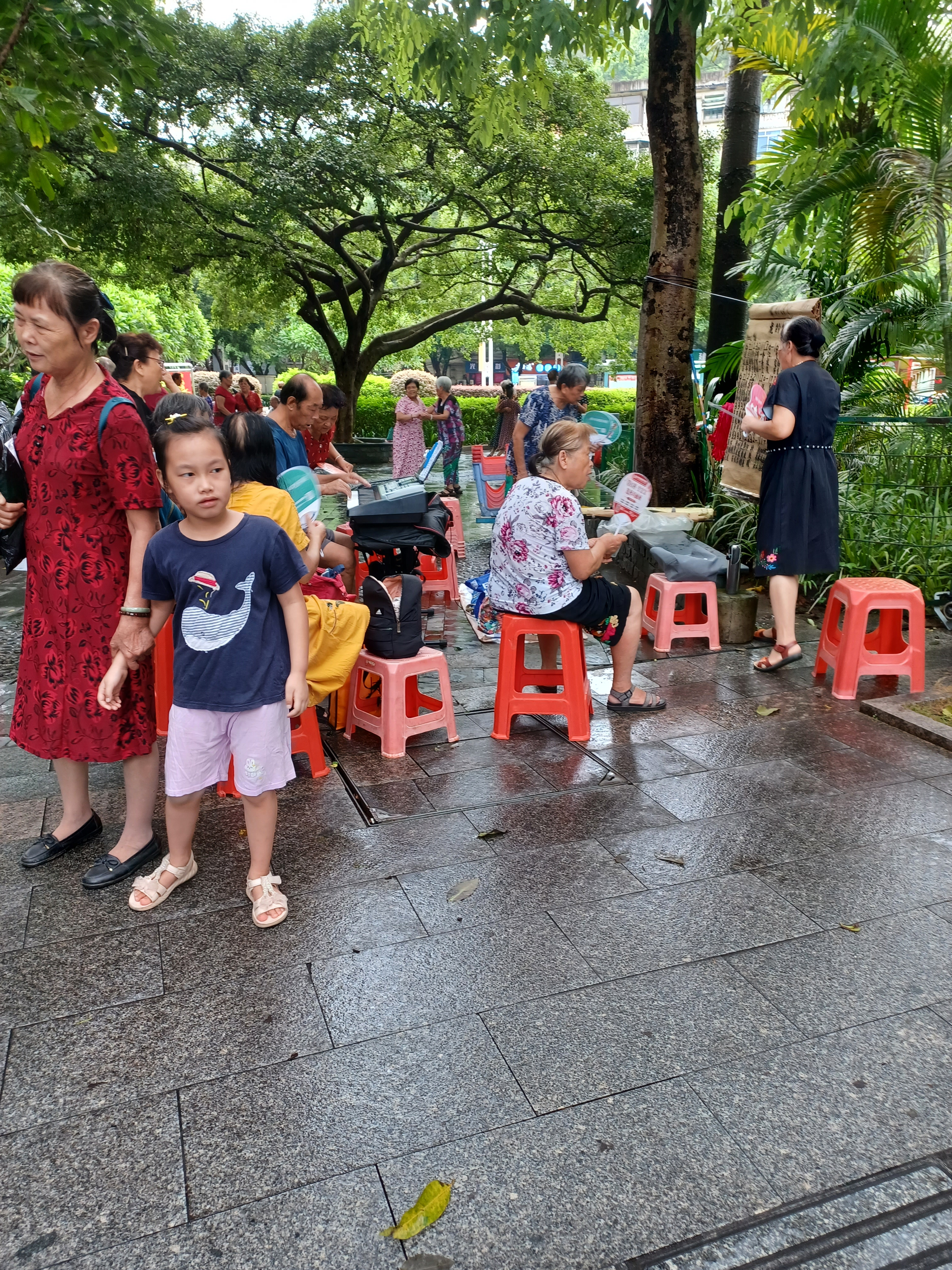
It’s a city where very few tourists ever go. On this trip, I didn’t see a single Westerner there, though I’d seen the odd one previously, and one of my wife’s innumerable cousins announced with surprise one night at dinner that I was the fourth foreigner she’d spotted that day!
Although we did, as I mentioned, spend time in Guangzhou, I’ll concentrate most of my remarks on life in Wuzhou, as it is this ‘life in an average city’ aspect, as well as time spent with ordinary Chinese families which I believe adds interest and validity to my account.
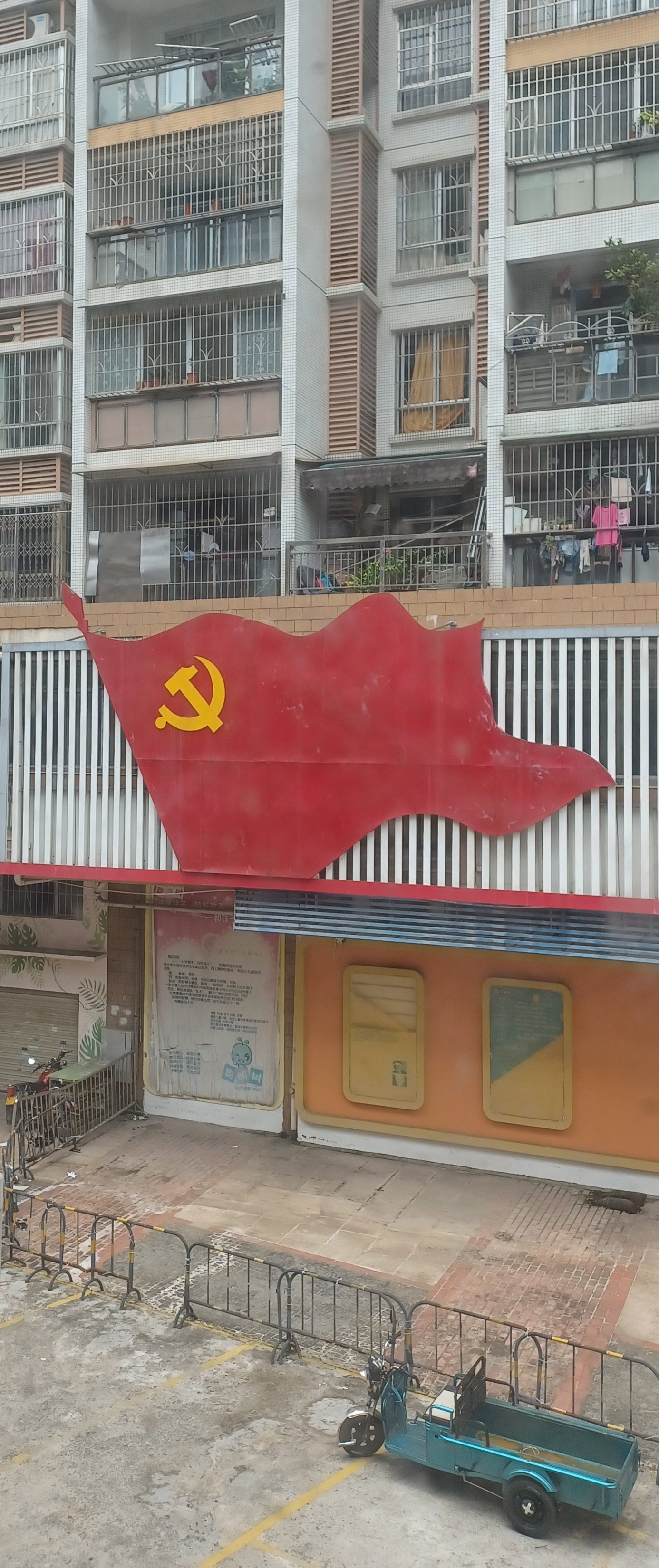
Debates around the nature of modern China are common on the left, both amongst the Heinz-variety of Trotskyist organisations, and those dwindling few who began life as Maoists, those who took the Chinese side during the Sino-Soviet split which became public during the early 1960s. These debates can, to outsiders, be akin to theologians discussing how many Angels can dance on the end of a pinhead, and I will avoid them here. Suffice to say, the consensus amongst most of the far-left milieu is that to the extent that China ever was properly socialist, capitalism has long since been restored there.
For the record, Britain’s biggest Communist Party, the Communist Party of Britain (CPB), of which I was once a member, enjoys some official recognition as a ‘sister’ party by the Communist Party of China (CPC). It is also, perhaps not coincidentally, the party that is most supportive of China today.
Aside from when it is directly relevant to my narrative, I will also avoid too much Chinese history, and specifically avoid attempting a ‘benefits/disbenefits’ cost analysis of the Mao period and what has come afterwards. Inevitably though, my own political views, after more than four decades of sporadic political activity, and which on this issue are still broadly in line with those of the CPB, will be revealed through the text, even if my conclusions at the end as to the applicability of the Chinese system to the West in general and Britain in particular will surprise many.
October 1st this year will mark the seventy-fifth anniversary of the foundation of the People’s Republic of China, and I’ve no doubt much will be written about it in the coming weeks, most of it critical here in the West. I hope my remarks will at least provide something a little different to both the political mainstream and the niche analysis of the Far Left.
Street Level Economics
Firstly, whether we describe China as ‘capitalist’ or not, there is no doubt that a vibrant and thriving free market economy exists there. Wuzhou has small businesses almost everywhere you turn although, and you wouldn’t know this without digging much deeper, some of them are still state-owned.
Mostly, as you’d expect of a society where food, the enjoyment of it, at home and outside and rarely eaten alone, is perhaps the principal glue that binds Chinese society together, this consists of eateries of various kinds.
Rice, noodles, vegetables, fish, seafood, tofu, cooked every which way, are all available at all times of the day, up until perhaps ten ‘o’clock night, sometimes beyond, and mostly at incredibly cheap prices, although the option to go more up-market is there too.
Wages are not high in China for the majority. But I believe it would not be difficult for the average person to eat two or even three healthy, nutritious meals a day outside of the home without bankrupting themselves.
Shopping on the market and cooking at home are popular too, though less so during the hot, humid, and sometimes wet summers (we experienced several torrential tropical downpours, especially in the afternoon).
Of course, you can eat McDonalds or KFC if you want also, a fact that some socialists bemoan. But why not? There’s nothing specifically anti-socialist about choice. In any case, these less healthy options are relatively expensive and don’t seem to be greatly popular, apart from as an occasional treat, which partly accounts for the almost total lack of youthful obesity.
Some also regret the growth of online shopping, particularly through Alibaba, which is the Chinese version of Amazon, though there are important differences regarding the amount of economic power they are allowed to wield. My wife pointed out one or two once-thriving indoor markets where half of the stalls are now empty because of this growth of online retail.
But there are still a lot of shops selling pretty much everything you need, a huge contrast with our near-dead High streets where it seems that little but charity shops (unknown in China) survive.
As well as the very many small Chinese businesses, all of the major clothing brands, like Nike and Addidas are also available, as well as the products of the top international electrical companies such as Apple and Samsung. These global products are not cheap, in fact, more expensive than here if average wages are taken into account.
It’s not uncommon, though less common than here to see young Chinese people wearing or using top globalist brands, though the homegrown Huawei seems to remain the most popular phone (and is part-owned by the Chinese trade unions, with some profits owned in trust for its workforce).
Chinese people often like to go for a walk around city centres and various shopping centres after their evening meal, especially on light summer evenings. The streets are often packed with people, of all ages and often in families, walking, browsing, shopping, grabbing an ice cream or a soft drink, stopping to drink tea, on which all Chinese people are experts, or coffee, and that’s if they’ve not chosen to have their main meal out.
There’s a big difference between a drinking culture and an eating culture, and there’s none of the ever-present hint of threat which can be felt if you venture into our town and city centres at night, a point to which I shall return. Public displays of drunkenness, which are not uncommon in Japan, a country with which they now possess many cultural similarities are virtually unknown.
It’s also not unusual to see organised groups of mainly, though not exclusively older people practising dancing, singing or exercising in the main city squares in Wuzhou at night, as in all Chinese towns and cities. In addition, Tai Chi is still regularly practised, mainly by older people, early in the morning, often in local parks.
Towards the Cashless Society
China is much further along the road to a cashless society than we are, and most payments, even for small items, are now made by simply scanning a barcode that is present in all businesses, literally on the table in restaurants, with a mobile phone and entering the correct amount for payment (WiFi passwords are generally prominently displayed on the walls inside of business premises and public buildings also). Interestingly though, and unlike here, all businesses by law have to offer a cash payment alternative. This is partly for the sake of foreign visitors, and partly for older, less tech’ savvy citizens. Sorting out a Chinese sim card and downloading payment apps like WeChat or Alipay is a good idea for tourists, though my wife used a spare family phone, and I stuck to cash.
Whether the mandatory cash option will remain is a moot point. Perhaps for foreign visitors, perhaps not for citizens.
To some extent, I lost my fear of a cashless society during this visit. The system is fast and efficient, and the Chinese seem at ease with it. It’s rare to see a local, even an aged local using cash.
However, and maybe some will think this naïve, if we are to have a society without cash, and I think this is probably inevitable in the West too, I’d sooner it be overseen and administered by a government that is at least subject to some public accountability (and contrary to Western opinion, sharp political differences do take place at all levels of Chinese society, and some contested elections also occur) and be led by a party of approximately ninety-five million members, which is to some extent meritocratic, and again which does have within it a degree of democratic structures. Better this than be imposed by a handful of bankers and Big Tech’ billionaires over whom we have zero control.
(China is not a one-party state. Eight political parties are in existence, though the seven minor parties all accept the hegemony of the CPC)
I’m not in a position to know how much the rapid move towards a cashless society, which had barely begun at the time of my last visit in 2013, is tied to the often criticised Social Credit system. I don’t speak either Cantonese, the first language in Wuzhou, or Mandarin, the national language of the nation, and very little English is spoken in Wuzhou. I’m guessing that, in any case, few would wish to engage me in serious discussion about this matter anyway, even if they could. But, from my understanding through reading and talking to those closest to me, I’m guessing that the principle of a system that rewards good behaviour and citizenship and penalises anti-social and illegal behaviour is one that will resonate with and have wide support amongst the Chinese.
A westernised social credit system would be very different to that which is being developed in China, and I’m far from convinced it would be better.
Would, for instance, a Chinese citizen be penalised for defending traditional views on sexuality and gender? Let’s not forget that here the rich person’s bank Coutts ‘de-banked’ Nigel Farage, an essentially mainstream politician with mildly Right-of-Centre views on issues like immigration because he didn’t ‘share their values.’ As far as I’m aware, ‘cancel-culture’ has no equivalent in socially conservative China, though I do know that people are not free to say or do whatever they want.
In principle, I’m not opposed to some form of social credit system, with proper accountability in place. But I do worry about how it would be administered here, in the ‘Democratic West’, and by whom.
Law, Order and anti-social Behaviour
Despite our being told constantly in the West that China is a ‘totalitarian tyranny’, displays of open state power are few and far between. There are staffed police stations dotted around Wuzhou, something of which I think most of us in Britain would be envious. But the sight of policemen and women on the street is rare, and the sight of soldiers, outside of areas of national importance such as Tiananmen in Beijing or in public parades on major holidays like International Workers’ Day or National Day is almost unknown.
I didn’t see any uniformed members of the People’s Liberation Army in Wuzhou or Foshan, or even in Guangzhou.
It could be argued that modern surveillance technology, such as facial, and body, recognition techniques, which are in large-scale use in China (as they increasingly are here) make visible law enforcement officers largely redundant.
But one of the two biggest differences I noted between my home city/country and China (I’ll come to the other difference later) is the issue of public safety. Quite simply, I could walk the streets of Wuzhou, day or night, without feeling in the slightest potential danger. I can’t say the same about Liverpool, and I doubt many would be able to do so about any town or city in Britain.
I’m old enough to remember when the first CCTV cameras started to appear in businesses and on our streets in the mid-late-1970s. They were sold to us as having the potential to greatly reduce and even eliminate street crime. Since then, the number of cameras has exploded, with each of us now almost permanently trackable as we go about our daily business (leaving aside the tracking device, or ‘phone’ we all voluntarily carry in our pockets). But are we any safer for it? Apart from their use in solving the occasional major crime, and identifying ‘troublemakers’ at demonstrations or football matches, what precisely are these cameras used for? Our leaders can lecture the Chinese about ‘freedom’ all they like, but at least their people are free to walk the streets in safety. It’s a sad thing to say for an Englishman, but I feel freer in China than I do here.
Even as ‘the only Westerner in the city’ in Wuzhou, nobody bothered me, other than to give me the occasional surprised, shy, interested glance, plus occasionally children saying ‘hello’, mainly to practice their English. Contrast this to visits to major cities in the Third World where, even if you are not in real physical danger, someone is always attempting to sell you something. Any idea that life in China is like life in the Third World, though I can’t speak of life in the more distant, rural villages of the country, is quickly dispelled by a visit.
Despite the obvious existence of the latest surveillance technology, China is, I believe, largely a self-policing society. For instance, you can walk for miles in Wuzhou, if you can stand the heat, and even in larger tourist areas like Guangzhou, and fail to see a single piece of litter on the ground.
This is something I’ve noticed on previous visits, when surveillance was less advanced, and the social credit system was still in the realm of ideas. I’d argue that the lack of litter and other forms of anti-social behaviour is due to that little thing called social disapproval, something we long ago lost.
Here, people, many of whom would no doubt call themselves ‘patriots’, often casually throw their takeaway wrapping or drinks cans onto the pavement, not only because of their own lack of pride and decency, and because they are unlikely to face any legal consequences to their actions, but primarily because other people will fail, often through fear of the consequences to themselves, to challenge them.
On the streets in China people, despite a natural politeness and reticence when it comes to conflict, would quickly make their feelings known if somebody casually deposited their rubbish onto the street.
Arguably, this is a South-East Asian trait rather than anything specifically to do with socialism. We could make the same points about the very definitely capitalist Japan, or South Korea, as well as about Vietnam, which does have a very similar social(ist) system to China.
On this issue, we can’t underestimate the influence of Confucian ethics, which govern social behaviour at every level, from the family to governmental relationships, and which spread outwards from the old Chinese Empire, the oldest of the Sout-East Asian societies, to the other countries in the region. Fortunately, the attempt during the Cultural Revolution of the 1960s to undermine and destroy the influence of Confucius, the ‘Sage of the Ages’, failed and is now long abandoned.
Religion

It should perhaps be mentioned here that the Maoist campaign against religion also failed and was largely, though not completely discarded.
Many temples which were partially destroyed in the 1960s, such as the ‘Temple Mount’ in Wuzhou, which I visited twice during this visit, have now been fully restored. These temples, almost uniquely in the world, tend to be non-sectarian in nature, with representations within of Confucious, Buddha, Lao Tzu, the possibly mythical/composite founding figure of Taoism, and other, often local, pagan gods and mystics. Chinese people see no contradiction between taking aspects from each of these religions, and indeed they are often spiritually/philosophically complimentary in any case. Ancestor worship is also popular. Indeed, China has a special holiday when ancestors are commemorated.
As for Christianity, I have twice attended an officially approved ‘Three-Selves-Protestant’ church in Wuzhou, including on this recent visit.
On both of my Wuzhou church visits, I’ve found the attendance to be good but, as is the case throughout most of the nominally Christian West, the congregation to be ageing.
On this visit, my wife also pointed out to me a local Catholic church, next to her former Primary school, which has apparently been in constant use since 1898, even through the height of Mao’s anti-religious fervour during the Cultural Revolution. Unfortunately, it is currently closed for repair work, but given that only an estimated six million Catholics live in China, out of a population of over 1.4 billion, I was surprised to see any Catholic place of worship in a city the size of Wuzhou.
It’s impossible to number the total amount of active Christians in China because of the existence of underground ‘house churches’ that reject the general government position that religious organisations are free to practice their faith so long as they refrain from engaging in anti-government, anti-state activities. I’m guessing that there will be more young people involved in these churches than in the officially approved churches simply because a proportion of youth will always be more attracted to radicalism than to conformism. But I’m guessing the numbers will still be relatively small.
In general, South Korea is the only South-East Asian country where we have seen Christianity become a substantial force. Even in Japan, a country where there wouldn’t seem to be any state stricture against Christian belief, only 1% of the population identify themselves as active Christians.
NB I’m trying to stick in this article to what I’ve seen, what I know, or at least what I can hazard a reasonable guess at. I will thus abstain from commenting on the treatment of the Uighur Muslims in the Xinjiang region, other than to say that, for those who are interested, there are plenty of counterarguments against the Western narrative that a ‘genocide’ is being committed there. Even Nick Clegg rejects that…
Similarly, there are good arguments on both sides as to whether or not Tibet should be a part of China. I’d love to go there and see the region/country for myself, but I don’t think there can be any doubt that Tibet has undergone massive economic development since China asserted direct control over the area in the 1950s, a period when the majority of people were still essentially Serfs living in conditions closer to the eighteenth than to the twentieth century. It also seems, as I’ve seen on a small scale in Wuzhou, that Buddhist temples are rapidly being restored and the mass repression of Tibetan Mahayana Buddhism is now, and hopefully permanently, a thing of the past.
Finally in this section, I’ll point out that President and Party General Secretary Comrade Xi Jinping has reiterated that religious belief is incompatible with membership of the CPC, members of which must maintain a ‘militant commitment to Marxist atheism’ if they are to remain members. I’m not sure how, or to what degree this rule is enforced, nor how it applies to China’s longstanding religions of Taoism and Buddhism, neither of which are theistic religions. In addition, Confucianism is a homegrown system of philosophy and ethics which has now been largely rehabilitated after the excesses of the Cultural Revolution, and there would now seem to be no conflict between reverence for the Great Sage and CPC membership.
Family Matters
It’s with the family that the renewed influence of Confucianism is most clearly seen in modern China. Gone are the days when the family unit was seen as a by-product of feudalism and capitalism which must be overcome to advance to the future utopia of communism. For me, who has increasingly come to see my own socialism as based on the ideal of the functional family (we all know many dysfunctional varieties exist), which serves as the model for a functional community, which in turn serves as the model for a functional nation-state, this is something to be welcomed.
What I can report from personal experience, is that both the nuclear and the extended family are alive and well in the People’s Republic of China. Keeping track of the innumerable aunts, uncles, and cousins (in the main Chinese languages, there are no single words to denote such relationships anyway. An ‘auntie’ will be given a title dependent on her age and place in the family, and the same is true for other members of the family. That’s a lot to keep up with, so I tended to stick with ‘aunty’ and ‘uncle’ though, confusingly, these are often used as honorific titles for older people in general, whether family members or not.)
As time has passed, over eighteen years since I was first welcomed into my Wuzhou family, numbers at the upper-age reaches have dwindled. Both of my wife’s parents were alive then, as were three grandparents, our children’s great-grandparents. Her dad passed away, as did his father (aged ninety-nine in the latter case, one hundred in Chinese terms as they start from one at birth) in 2013, shortly after my last visit. Now, of these most immediate family members only her mum, our children’s grandmother, remains. But the wider family is still close, in both geographical and emotional terms.
Filiality towards one’s parents is the cornerstone of Confucianist ethics. Children are expected to look after their parents. My wife’s mum shares her apartment, which was initially bought by her husband, with her son, daughter-in-law and two granddaughters.
When and if the time comes when children can no longer take care of a parent, parents or grandparents, then the whole family will routinely chip in so that the best care possible can be afforded, either through paid extra support at home or in a residential setting.
In this area at least, China is much closer to a Traditionalist than a traditionally socialist society.
On the Environment
China is greatly criticised in the West for its pollution. Human-created climate-change sceptics, amongst whom I tentatively number myself, often point out that whilst we talk about ‘five-minute cities’ and the need to start accepting ‘climate refugees’ and the like, China continues to open a new coal-fired power station every week. I’ve no doubt this is true and I’m also in no doubt that the experience of living next to one of these stations is very different to that of living in Wuzhou.
But it is also true that China now leads the world in the development of renewable energy sources.
And, based purely on my observations, an average city in China, such as Wuzhou, is much more environmentally friendly than an average city in the UK. For one thing, the main means of getting around the city is by cheap, fast, efficient public buses, or even more so, by electric motorbikes/Scooters (‘Mod’ style scooters, not those electric versions of children’s scooters, the ideal vehicle for muggers and thieves, which have been forced upon us in Liverpool and some other British cities.)
These electric motorcycles are ideal for swerving in and out of cars and buses, and also for serving around pedestrians (there’s an art to crossing the road in a city like Wuzhou. The secret is to nonchalantly stride forth, trusting that drivers of vehicles will be aware of you enough to take appropriate action) and are of course ecologically sounder than the diesel-based motorcycles which were prevalent on previous visits (if less so than the classic Maoist bicycle of the past).
Secondly, everything is much more localised. Members of my wife’s family hold a variety of jobs (her brother is an electric bike salesman, as it happens. His wife works in a restaurant. One cousin works in a bank, another cleans in a shopping centre etc). But they all seem to work within a mile or two of where they live.
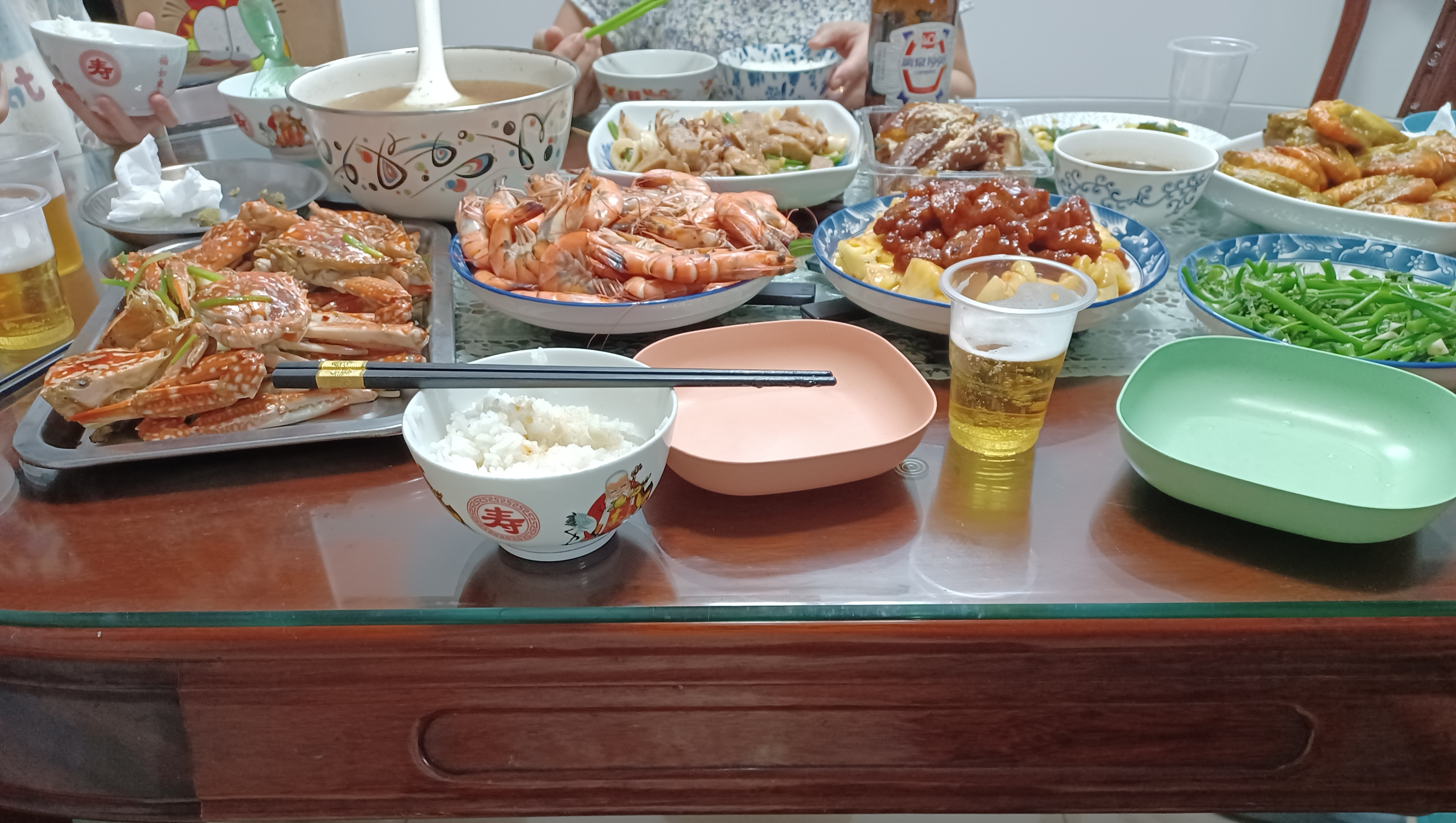
As I’ve said, most people eat out very regularly, and food is produced quickly, whilst you wait on the premises. I’m guessing also that most of it is produced nearby. It should also be mentioned that every meal out inevitably ends with the supply of ‘doggy bags’, as people routinely share out and take home whatever is left, and this tends to be a lot, such are the plentiful portions in Chinese eateries, to consume later.
And this is by order of Comrade President Xi himself.
Nothing goes to waste.
I will also mention that the river which divides the old and the new parts of Wuzhou, linked by both a pedestrian and a road bridge, is clean enough to swim in, and this is something my wife often did as a girl, and people, old and young, still do. It’s also a popular place to fish. Naturally, on the basis that nothing should go to waste, the fish caught, though small, are taken home to eat, not put back in the river, though I’m guessing that informal agreements prevent overfishing.
Having mentioned the almost total lack of litter on the streets, it will come as no surprise that bins for both general waste and recyclable waste are supplied, and that, as in Japan, people carefully select the correct bin for the correct rubbish. It will also come as no surprise that unlike here, where recycling is stockpiled and often sold abroad, including to China, whatever can be re-used locally is used locally.
Bins in residential area are emptied on a daily basis, a fact which seems almost unbelievable when our own local authorities often struggle to maintain weekly collection services.
As a further aside regarding electric motorbikes. It is the law, as you’d expect, that both riders and passengers are required to wear a safety helmet when mobile on a bike of any sort, either as driver or passenger.
But it may come as a surprise to those who imagine a people so cowed by authority that they routinely follow every demand of their national and local leaders, that this law is widely ignored
As the old saying goes, ‘China is big and the Emperor is far away,’ which clearly remains the case despite the growth of remote surveillance.
The Display of Politics and History
As there are very few uniformed officers of the state to be seen in Wuzhou, then so also are ostentatious displays of political ideology. The only Mao poster, a copy of the iconic Tiananmen portrait I saw on display was in the security hut outside of the block of flats where our rented apartment in Wuzhou was situated, though I saw a few framed copies of the Great Helmsman at various stages of his life for sale in photographic studios and art shops.
I also saw no visible evidence of a Cult of the Personality around President Xi.

But my wife did take me to a large obelisk-type ‘Monument to the Revolutionary Martyrs’ with an attached museum. I hadn’t previously known this existed, but my wife said that the monument had been there when she was a schoolgirl, and every year, around National Day, which takes place on October 1st each year, they would go in their school uniforms to lay flowers. Back then it had been surrounded by rough ground, and the museum had yet to be built.
The museum itself contained some great artwork, in the Socialist Realist style of course, and explanatory plates, much of this concerning the forced opening of Wuzhou as a ‘treaty port’ by the British in the 1890’s. This had happened with many Chinese cities during the previous half a century, starting with Hong Kong via the first Opium War in the 1840s. One striking piece concerned a strike by workers in many British-owned firms that took place in protest at poor wages and conditions, at a time when ‘we’ had just spent lavishly on a plush new consul.
What I liked about this piece, and about the museum in general was that it showed how even a relatively minor Chinese city like Wuzhou had their share of trade union/working class struggles. They played their part in the national-anti-imperialist struggle and they are remembered for it, as they should be.
Public buildings, like the Wuzhou City Council offices also looked suitably imposing in the elegant but functional Socialist Realist style.
Overall…
I came away from China with an almost wholly positive view of the country. This has been true also of my four previous visits but was still more true on this occasion.
The streets of Wuzhou are, as I’ve said, busy, vibrant, clean, safe and environmentally friendly. Free and hygienically maintained public toilets are never more than a few minutes’ walk away either, which might seem like a small thing but are important for people’s comfort, and are, I like to think, one of those aspects of socialism that most certainly does survive.
I’ll finish with the question I posed in the title: ‘Does it work?’ Well, yes it does. China is now the second biggest economy in the world, and it’s achieved that, by and large, through its own efforts, and without invading other countries. Its people appear happy, content, well-fed, and above all, hopeful. Chinese people seem to expect that their nation, and they very much do believe it to be their nation will soon be the strongest on Earth, at least economically (contrary to Western propaganda, China historically have done virtually everything possible to avoid having to fight wars, though certainly they are more militarily prepared if the worse comes to the worse now than ever before), that their children will be better off than they are, and that their children in turn will be better off still.
This is not really surprising, given that someone like my children’s grandmother, who at seventy-five is as old as the revolution itself, has lived through a major famine in the late 1950s and the ultra-leftist madness of the Cultural Revolution in the 1960s, but has still seen life expectancy more than double in her lifetime, as well as approximately four hundred million people being lifted out of poverty since the late beginning of the economic reforms in the late 1970s.
The state-directed market economy, built upon the socialist foundations established under Mao (at admittedly great cost), clearly has produced the goods for China.
But could it work here, in Britain or as a general model for the West?
Comrade President Xi has added the phrase ‘Socialism with Chinese Characteristics’ to the lexicon of Marxist discourse. I like the general idea of ‘Socialism with ‘X’ national characteristics. Britain has different traditions to China, including traditions of human rights and individual liberty that are unknown, and in my experience baffling and undesirable to the average Chinese. Socialism would naturally look different here.
All nations have their own history and culture, and it always was a mistake by communists to attempt to oppose a single Soviet-style planned economy everywhere.
But I will repeat the point I alluded to earlier. That is, we are probably heading towards something that will have some similarities to the Chinese system anyway, only in a globalised form, not based on any national characteristics or traditions, and administered not by a mass party and local and national governmental bodies that have evolved over many decades, but by a handful of billionaires and super-national corporations.
Would it not be better if we took advantage of the opportunities afforded to us by Brexit and developed our own socialism with national characteristics, or if the majority can’t bring themselves to embrace any form of ‘socialism’ then at least something with national characteristics? Wouldn’t that be better than a globalised, amorphous, mass tyranny imposed from above?
I will end on perhaps my most controversial point. That is, that it may already be too late for us in any case.
Monoculturalism and Multiculturalism
The reason for that is that China has done something we have failed to do, that is to maintain their integrity as a virtually mono-cultural ethno-state. I realise that my views make me virtually friendless amongst socialists and communists here. But I have become convinced, more and more convinced as the pace of demographic change has accelerated, and at a seemingly ever more rapid rate, that socialism, any form of socialism depends on a high degree of social cohesion; and that the twin evils of mass immigration plus multi-culturalism have all but destroyed whatever social cohesion we once possessed, and which the People’s Republic of China still possesses.
Of course, I’m in no way an absolute ethno-nationalist, still less a White Supremacist. Given that I am married to an immigrant, I would be a total hypocrite if I was. But I think that for a society to function well, even forgetting terms like ‘socialism’ for a moment, requires a big majority, a super majority as some call it, with a common heritage, culture, language and values. We have allowed a situation where the indigenous people are now a minority in some of our major cities, including in our capital city. Chinese people, those who I’ve been able to talk to, think that this is insane. Not so long ago, we too would have thought it insane.
Arguably, China is itself multicultural in that different tribes, languages, dialects, customs etc exist side by side within the country. My wife is Han, the majority, and arguably the dominant tribe, though the Manchus always produced the Emperor back in the two hundred-and-sixty-eight-year period of the Qing Dynasty which ended with the founding of the Republic under Sun Yat-sen in 1911. I’ve already mentioned the Uighurs and the Tibetans. Then there are the Mongols (Inner), and many more.
Clearly, questions of minority rights and local autonomy arise and the West seeks to exploit them as a means of weakening China, as they did previously in the USSR, Yugoslavia and elsewhere.
But in China, by and large, these different local and national identities have lived together in a single civilisation for a very long time, and above anything else, the vast majority of the people are first and foremost Chinese. Barring the catastrophe of economic collapse and/or defeat in war they will never undermine their national identity by allowing tens of millions of outsiders from very different and often mutually incompatible cultures into their country on anything other than a very temporary basis.
(I have mentioned that I saw few non-Chinese faces even when visiting the metropolis of Guangzhou. I will add that I didn’t see a single black face, even though up to a million black Africans are currently stationed in the city, learning how to work and administer the large numbers of businesses China has recently established in Africa, and the large chunks of land they have purchased as part of the Belt and Road Initiative. These Africans are there to learn to learn to do a job and then return to their own countries to do it. That they seem invisible on the streets suggests that, rightly or wrongly, they are at best strongly discouraged from mixing with the Indigenous Chinese people).
To those on the Left who seem to value an ‘open door’ policy, I would ask simply, does this ever-growing plethora of national identities contribute to clean and safe streets? Is it wise to import sectarian conflicts from elsewhere into our country? Does mass immigration help our environment, ease our shortage of affordable housing or the pressures on our public services? Does it make it easier or harder to build a culture of resistance to economic and political injustice?
I believe the answer to all these questions is a big ‘no’.
Putting on my Marxist hat for a moment, if indeed I ever truly removed it, I would argue that the large numbers of legal migrants, those who are coming to our country to work (there are also a lot of legal scams not connected to work that allow people into the country as well, but I’ll leave them aside) play a role in undermining the pay and conditions of the Indigenous working class, something our trade unions once understood. When it comes to illegal, undocumented immigration, often of criminal elements, then these types are akin to an internationalised version of what Marx termed the lumpenproletariat, a section of society whose behaviour can make life a misery for many decent hardworking people, as well as playing a potential role of mass scabbing during times of industrial conflict.
These elements also often bring with them regressive attitudes when it comes to such things as women’s and gay rights.
But, most importantly, as I have indicated, both legal and illegal migration severely undermines the social cohesion which I’ve hopefully identified as necessary for the building of a decent society, and necessary for the success of the modern People’s Republic of China.
In Conclusion
I believe that Chinese Market Socialism if I can use that term, is a valid workable future model for us, but only on the proviso that we find a way to return to a largely monocultural society.
That’s easier said than done, and the question therefore becomes one of how to get to there from where we are now, and is the price of getting there worth paying?
As one ray of hope worth investigating, I will point out that in Western Europe some parties of the Left, particularly the Social Democrats of Denmark, have seemingly learnt the lessons of past mistakes and are seeking to reverse the errors of mass immigration and multiculturalism. It’s a long way from the People’s Republic of China, and we are a long way from anything like that here in Britain. But at least it’s something.
Anthony C Green, August 2024
For those interested in theoretical questions, such as whether China can still be classed as a socialist nation, then this new article, which I discovered whilst writing this article, and which despite its Trotskyist origins gives very strong evidence as to why China today is neither imperialist nor capitalist, is a decent place to start
The Class Nature of China | Spartacist (English edition) (iclfi.org)
The website below produces some excellent pro-Beijing articles
This week’s posts from Friends of Socialist China
The writings of John Ross, who generally writes on the Socialist Action website are also well worth reading
 THIRDWAY THINK-TANK | The Voice of the Radical Centre
Discussion
No comments yet.