National Overview
On Saturday, towns and cities across the UK witnessed public gatherings linked to the so-called Great British National Strike, an event promoted primarily through social media platforms, Telegram channels, and a loose network of populist and nationalist influencers. Though the term “national strike” was used, there was no involvement from recognised trade unions or official strike activity in workplaces.
The demonstrations appeared to draw together individuals disillusioned with mainstream politics, often rallying around themes of national sovereignty, freedom of speech, and opposition to globalism, migration policy, and the political establishment. Promotion came from a mixture of minor political activists, online accounts with patriotic branding, and anonymous coordinators calling for a “people’s uprising.”
While no single organisation took formal responsibility, promotional materials circulating online used generic calls to action such as “take back our country” and encouraged turnout under banners like British Patriots Rise, UK Freedom Movement, and similarly styled slogans. However, there was notable absence of explicit party or group logos on the day itself.
In most locations, the “strike” supporters were countered by Left-wing activists, including members of groups like the Revolutionary Communist Group, Socialist Alternative, trade union contingents, and antifascist networks. These counter-demonstrators often outnumbered or out-organised the initial rallies.
Despite the potential for conflict, events remained largely peaceful, requiring minimal policing, although minor incidents were reported in some areas.
Liverpool Report – St George’s Hall Gathering
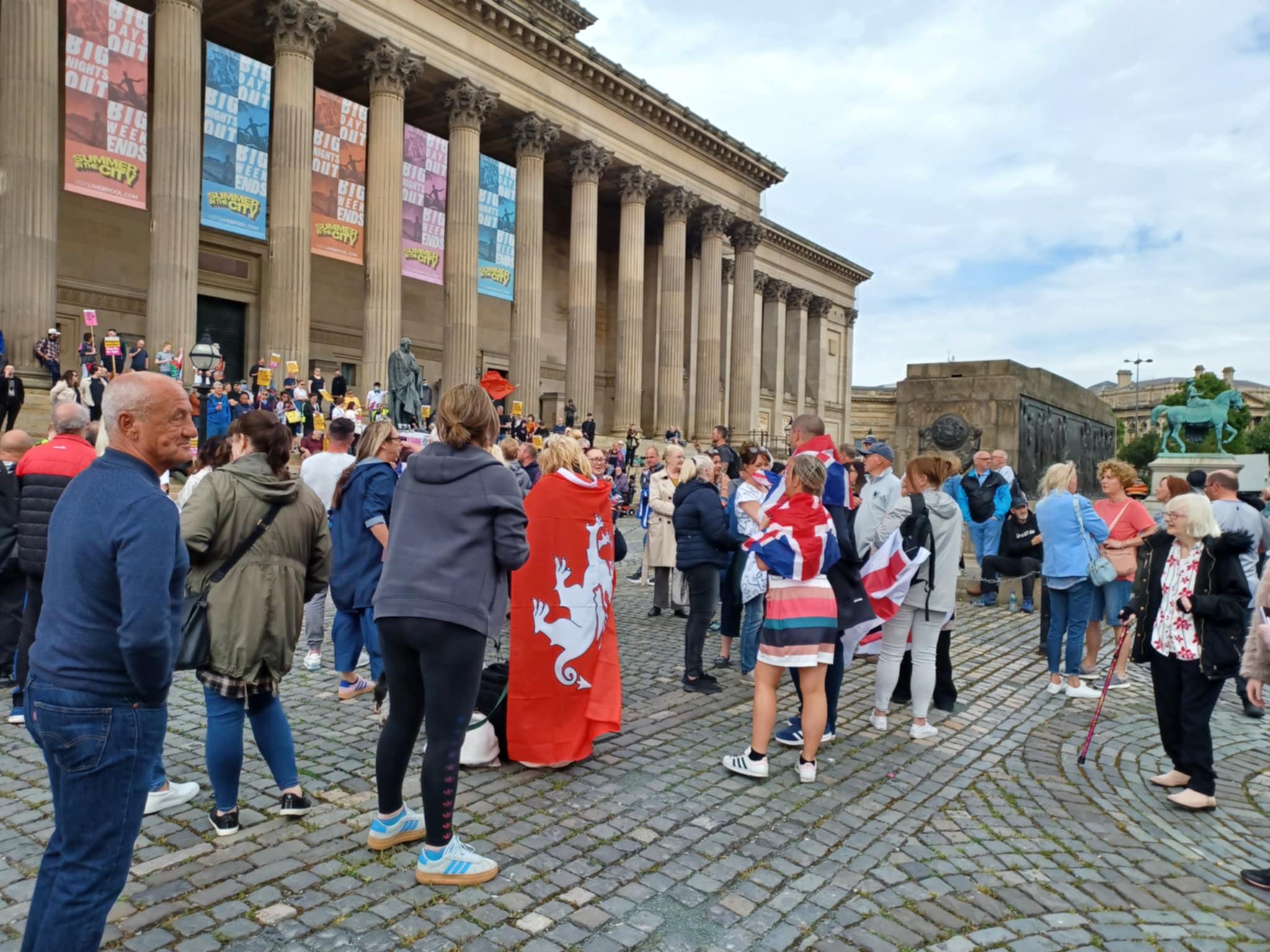
In Liverpool, the event took place in front of St George’s Hall, with around 200 people showing support for the Great British National Strike. Their presence was marked by Union Flags, St George’s crosses, and hand-held signs reflecting anti-establishment sentiment. Some wore clothing bearing slogans such as “We will not comply” or “Save our country.”
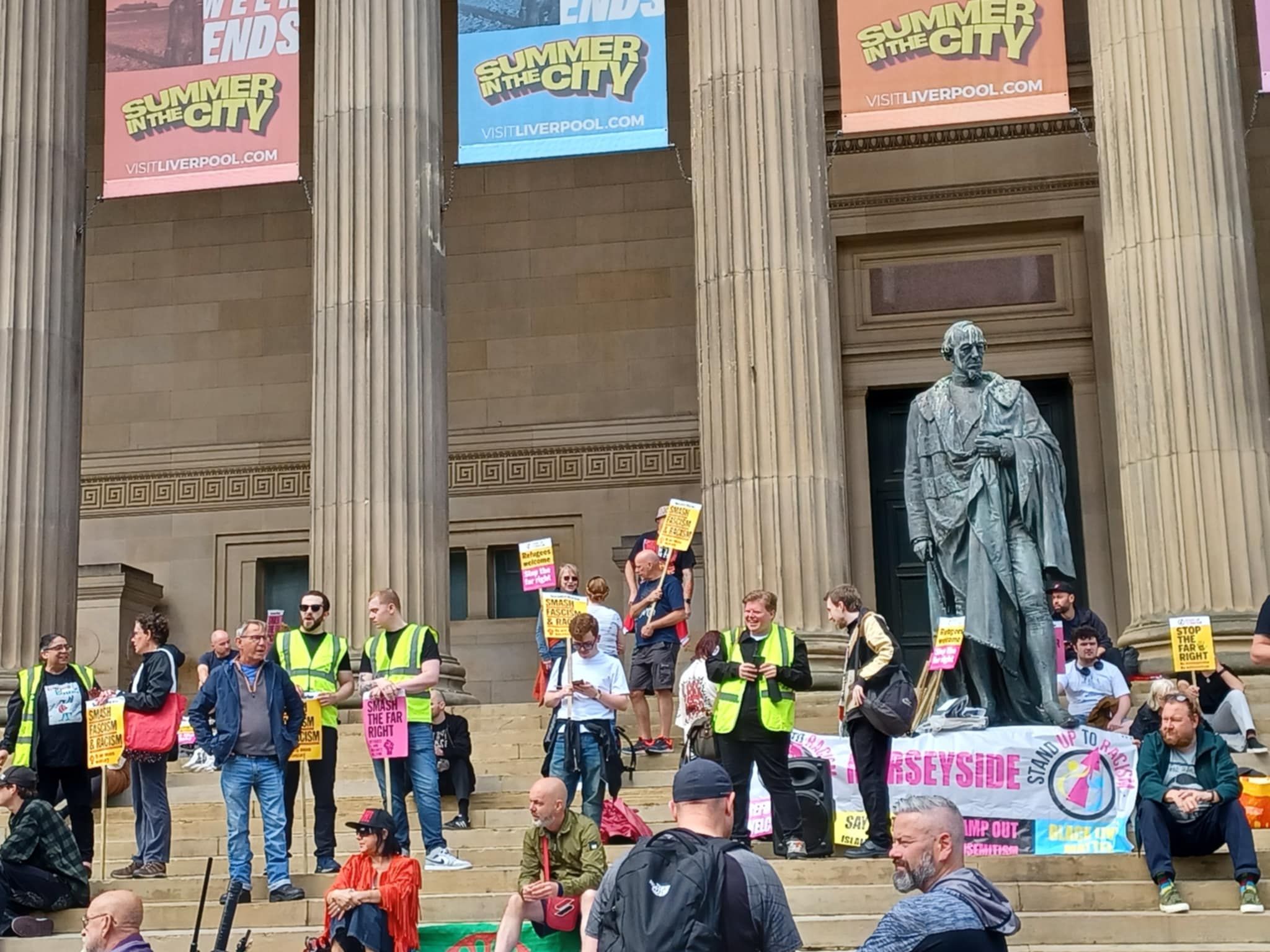
Across from them, occupying the steps of St George’s Hall, stood a similarly sized and more tightly organised group of counter-demonstrators. Among those clearly present were the Revolutionary Communist Party, Revolutionary Communist Group, and Socialist Alternative. Many participants were experienced in protest logistics and had access to microphones, banners, and loudhailers.
While the original strike supporters did not openly display affiliations with organised far-right groups, it is likely that the event was mobilised through informal online networks associated with right-leaning populist causes. As in other cities, no visible leadership or formal coordination was on display.
Despite the ideological divide, the event was largely peaceful, with minimal police presence. Only one notable scuffle occurred when an individual carrying a Union Flag attempted to ascend the steps, sparking a brief confrontation.
Although the counter-demonstrators’ chants, including “Get the Nazis off our streets,” were typical of antifascist protest language, these did not appear to reflect the actual composition of the group they opposed, who were mostly middle-aged and older individuals rallying under patriotic rather than explicitly ideological banners.
Conclusion
The Great British National Strike was not a coordinated labour action, but rather a decentralised protest movement driven by grassroots discontent and amplified via online networks. Its lack of central leadership, formal structure, or coherent policy platform underscores the fragmented nature of modern political mobilisation—especially on the nationalist-populist end of the spectrum.
In Liverpool and elsewhere, the symbolic clash between rival protest cultures—patriotic populism versus anti-fascist mobilisation—was conducted mostly without incident, though tensions were clearly present.
These events point to a growing distrust of institutions, a willingness to take grievances to the street, and the continuing presence of a cultural and political divide in post-Brexit Britain. While the turnout may not have been overwhelming, the visibility of confrontation suggests these competing visions for the country will continue to clash in public forums.
 THIRDWAY THINK-TANK | The Voice of the Radical Centre
Discussion
No comments yet.