Across the Atlantic, the brutal shooting and murder of Charlie Kirk has unleashed calls for vengeance, while here in Westminster, insults and threats have eclipsed sober debate. This article traces the ripple effects of violent rhetoric in both the US and UK, exposes even the UK Left’s shocking justifications for assassination, and argues that alongside the freedom to speak, we must revive the freedom not to speak—choosing silence and restraint as acts of civic courage.
We have reached an alarming crossroads: in the United States, the assassination of conservative activist Charlie Kirk on a Utah campus prompted celebration and justification from some. The far-left Socialist Worker said: “Some on the left have pointed out that Kirk was a human being with a family. That is true. But those human beings who devote their lives to oppressing, marginalising and humiliating should expect their chickens to come to roost.” The article was headlined: ‘Charlie KKKirk’s chickens come home to roost’. There is no credible evidence that Charlie Kirk has ever been a member of, supported, or had any organizational ties to the Ku Klux Klan. Of course that doesn’t stop some from publishing this lie. Dehumanisation and demonisation are just the prelude to violence and persecution.
Homegrown violent rhetoric has also seeped into our own streets, with some far-right protesters bearing placards that depict MPs in crosshairs, chanting for “direct action” against elected officials. The language of violence and hate is no longer fringe—it has infiltrated mainstream discourse on both sides of the Atlantic.
Yet the erosion of civic restraint is not confined to domestic actors. At the recent Unite the Kingdom demonstration, a videolink appearance by Elon Musk—urging British voters to “shake off the shackles of socialism”—was met with both applause and alarm. While some welcomed his intervention as a gesture of solidarity, others saw it as a troubling instance of foreign influence in our democratic discourse. Musk’s remarks, broadcast from California, were swiftly followed by a chilling moment: one demonstrator, captured on camera, called for the assassination of Prime Minister Keir Starmer. That such a statement could be uttered in public, without immediate and universal condemnation, marks a dangerous descent into political nihilism.
As Nationalists, we utterly oppose American interference in our domestic politics, as we would any other country’s. Sovereignty is not a slogan—it is a principle rooted in democratic self-determination. Our debates must be shaped by those who live with their consequences, not by billionaires beaming in from abroad. The spectacle of foreign tech moguls weighing in on British policy, while domestic voices are drowned out by chants of violence, is not a sign of strength but of civic decay.
We must draw a firm line: between solidarity and meddling, between protest and incitement, between speech and sabotage. The path back to civility begins with reclaiming our own voice—uncoerced, unthreatened, and unbought.
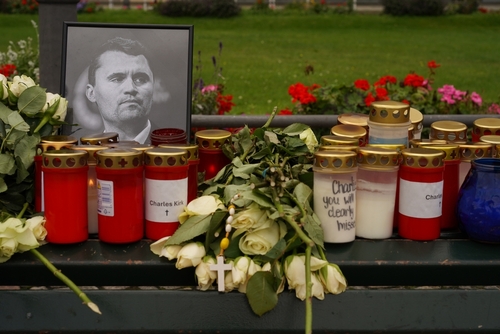
Across America, the past few years have seen a torrent of attacks on public figures. In September 2025, Charlie Kirk was gunned down mid-sentence, his killer’s engraved bullet casings taunting “Hey, fascist, catch!” Earlier in 2025, a would-be assassin opened fire near a Donald Trump rally. In 2024, Minnesota state representative Melissa Hortman and her husband were shot dead by a man who had drafted a “hit list” of Democratic officials. Pennsylvania’s governor survived an arson attempt on his family home after extremist agitators objected to his stance on Gaza. And of course, January 6, 2021, remains the starkest reminder: a mob storming the U.S. Capitol, five people dead, more than a hundred law-enforcement officers injured, democracy itself under siege.
Here in Britain, the Commons has lost its decorum. By convention, MPs avoid direct accusations of lying, opting for the euphemistic “terminological inexactitude.” Yet recent sessions have been littered with shouts of “liar,” “muppet” and even calls to “lock them up.” In one debate on the Health and Social Care Bill, an MP’s claim that ministers were “murdering patients” forced hurried apologies from both speaker and attack-maker. Every viral clip of shouting matches chips away at public trust in our institutions and invites real-world violence into our civic life.
Worse still we’ve seen unprovoked attacks on the Police from all parts of the political spectrum. This is unacceptable. The police are workers and any unjustified abuse of workers is rightly condemned by unions and all right-thinking people. The police are not responsible for government policy and are tasked with keeping the peace without fear or favour. We must understand the difficult and dangerous job they are tasked to do and remember they have the right to go home to their families un-injured.
What unites these scenes is a surrender to spectacle over substance. When calls to “exterminate the enemy” or cheers for an assassin’s bullet go unchallenged, we normalize violence as political currency. We have forgotten that alongside the sacred right to speak freely stands an equally vital freedom: the freedom not to speak. To pause before retweeting a bloodthirsty slogan. To refuse to amplify a dehumanising slur. To choose silence over the roar of outrage.
Reclaiming our civic culture starts with small but crucial acts of restraint:
- Teach pause and reflection: in schools, workplaces and online platforms, reward those who ask “Is this necessary?” before hitting send.
- Insist on substance over spectacle: spotlight leaders and commentators who debate policies calmly, not those who whip up fear for clicks.
- Defend neutral spaces: support public broadcasters, local newspapers and community forums where nuance can flourish beyond echo chambers.
- Remember that violence against Police officers fulfilling their proper duties is unacceptable. Keep protest peaceful.
- If you are a Police officer be patient and reasonable and uphold everyone’s right to protest peacefully without overly restrictive conditions.
- Model silence as strength: every time we refuse to retweet a threat or hurl an insult in parliament, we puncture the momentum of contempt.
The candlelit memorial for Kirk and the tense hush after rancorous Commons exchanges remind us that the cost of violent rhetoric is always measured in human lives and the fraying of our shared bonds. Democracy is not warfare; it is a conversation sustained by reason, respect and sometimes the courage to say nothing at all. Let us choose words that build, pauses that heal, and a silence that speaks volumes for our collective dignity.
By Patrick Harrington
 THIRDWAY THINK-TANK | The Voice of the Radical Centre
Discussion
No comments yet.