There’s a particular British mood that settles in whenever the world news gets a bit too dramatic. You know the one — you’re watching a report about rising oil prices due to conflict in the Middle East, global markets twitching like a nervous cat, and politicians insisting everything is “under control”, and suddenly you find yourself thinking: I should probably pick up an extra bottle of washing liquid.
Not because you’re preparing for the end of civilisation.
Just because you’ve lived long enough to know that global events have a habit of sneaking into the weekly shop.
Even Moses, in the Book of Genesis, advised Pharaoh to build reserves in times of plenty — though let’s be honest, we’re not exactly living in times of plenty. Still, the principle holds: a little preparation goes a long way. And unlike Pharaoh, we don’t need granaries the size of cities. Just a few sensible bits tucked away, ideally bought slowly, over time, and when they’re on offer.
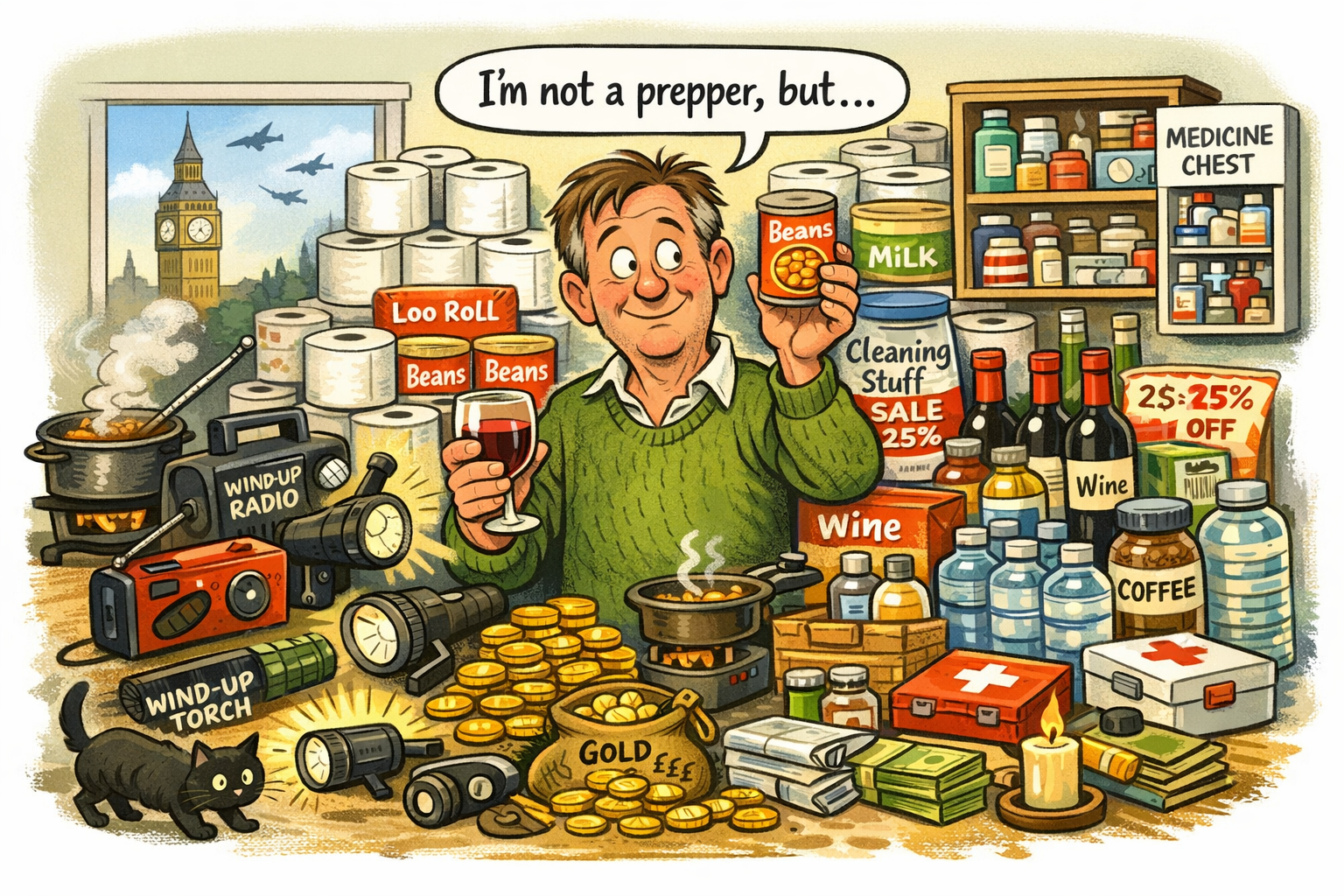
I’m not a prepper. Truly.
But I am someone who remembers the blackouts of childhood — the candles, the hush, the adults muttering about industrial action — and who likes to feel steady when the world wobbles.
🌍 When Global Politics Meets the Price of Beans
The thing about global economic shocks is that they don’t stay global. They wander into your supermarket like they own the place.
Oil prices rise?
Suddenly:
- food distribution costs climb
- heating bills creep up
- anything made of plastic becomes mysteriously “premium”
- and your shopping bill starts behaving like it’s trying to escape orbit
You feel it first in the basics:
Coffee.
Cleaning products.
Tinned goods.
Toilet roll — the nation’s emotional seismograph.
This isn’t panic. It’s pattern recognition.
So what do you do?
You don’t build a bunker.
You don’t start stockpiling lentils like a Victorian survivalist.
You simply get… sensible.
🧼 The Three‑Month Cupboard: A Very British Kind of Resilience
Some people call it prepping.
I call it being raised in a country where candles were a household essential because the power might go out mid‑Blue Peter.
My approach is modest: a three‑month supply of the things I’d rather not run out of during a crisis, a storm, a strike, or a sudden price spike — built up gradually, affordably, and ideally on offer.
My “I’m Not A Prepper” Essentials:
- Coffee (the cornerstone of civilisation)
- Milk powder
- Tinned goods (beans, tomatoes, soups — the holy trinity)
- Soap
- Toilet paper
- Rubbish bags
- Washing liquid
- Washing powder or pods
- Handwash powder
- Bleach
- Cleaning supplies
- Candles and matches
And yes — a respectable wine stock, because if the world is going to wobble, I’d prefer to face it with a glass of something decent. Not panic‑buying. Just… morale management.
💡 The “Slightly Adventurous” Kit
Not survivalist.
Just practical.
- Wind‑up radio
- Wind‑up torch
- Water purification tablets
- Large water bottles
- Camping stove
- A growing interest in a solar generator
These aren’t signs of paranoia. They’re signs of someone who remembers the 1970s and has no intention of eating cold beans in the dark ever again.
🛒 Bargains, Offers, and Beating Inflation at Its Own Game
Preparedness doesn’t have to be expensive.
In fact, it’s often cheaper if you’re strategic.
Take advantage of:
- two‑for‑ones
- multibuys
- seasonal reductions
- and the occasional supermarket miracle
Right now, for example, Tesco is currently offering 25% off household cleaning items if you buy five.
That’s not prepping — that’s just being clever.
If you’re going to buy washing liquid, washing powder, bleach, and cleaning spray anyway, you might as well do it when the universe is offering a discount.
💷 Cash, Gold, and Quiet Confidence
Card machines are brilliant… until they aren’t.
A small stash of cash tucked away is just common sense.
Not a dragon’s hoard — just enough to get by if the tills go down.
And yes, I’ll admit it:
I keep a couple of gold sovereigns.
Not because I’m planning to trade them for bread in a dystopian future, but because they hold value in a way that feels timeless and reassuring. The financial equivalent of a sturdy winter coat.
💊 The Medicine Chest of Calm
A well‑stocked medicine cabinet is one of the most underrated forms of household resilience.
- Painkillers
- Cold & flu remedies
- Antihistamines
- Plasters & bandages
- Antiseptic cream
- Rehydration salts
- A thermometer
- Spare glasses or lenses
Just keep an eye on the use‑by dates — nothing says “prepared” like discovering your cough syrup predates the millennium.
🧺 The Overlooked Heroes of Household Stability
These are the things you don’t notice until you run out of them — and then you notice very loudly.
- Batteries (all the sizes, including the weird ones)
- Foil, baking paper, and cling film
- Zip‑lock bags
- Rubber gloves
- Sponges & cloths
- A manual tin opener
- Duct tape, cable ties, and a basic tool kit
- Blankets, hot water bottles, and thermal socks
- A flask (for tea, morale, and dignity)
If you have pets:
- extra food
- spare litter or bedding
- any medications
- a backup lead or carrier
Because nothing says “crisis” like running out of cat biscuits.
🌱 Prepared, Not Panicked
I’m not a prepper.
But I am someone who likes to feel steady in a world that occasionally wobbles.
Keeping a few months’ worth of essentials isn’t about expecting disaster.
It’s about smoothing out the bumps — the price spikes, the shortages, the storms, the strikes, the unexpected moments when the lights flicker and you think, oh no, not again.
It’s a small act of self‑reliance.
A nod to childhood memories.
A quiet acknowledgement that the world is unpredictable, but your cupboards don’t have to be.
And honestly?
There’s something deeply comforting about knowing that whatever happens — geopolitics, supply chains, or the British weather — you can still make a decent cup of coffee and open a nice bottle of wine.
By Pat Harrington
Advert

 THIRDWAY THINK-TANK | The Voice of the Radical Centre
Discussion
No comments yet.