By Patrick Harrington
Modern conflicts from Ukraine to the Middle East reveal how cheap drones, covert killings and real-time propaganda are transforming the nature of war. Swarms of drones can strike tanks and ships for pennies on the pound. Targeted assassinations decapitate enemy leadership with surgical precision. Meanwhile, social media and war bloggers on Telegram shape global opinion before traditional news can even catch up. For Britain, this is not just a distant curiosity — it is a wake-up call.
Drones: The New Frontline
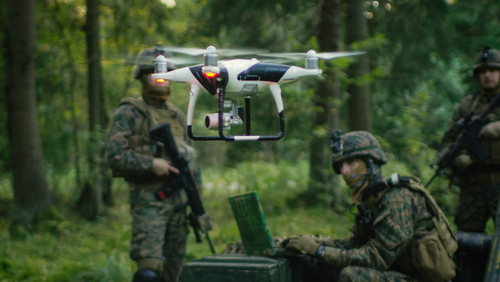
In Ukraine, a “drone army” has demolished high-value Russian assets using thousands of mass-produced quadcopters and loitering munitions. Hamas, Hezbollah and Iranian-backed groups deploy drones and remote-controlled boats to harass modern navies and commercial shipping in the Red Sea. In recent attacks drones have been launched from within enemy territory in intelligence operations. Smuggled int Russia or Iran by agents. This new technological leveller flips the old cost advantage enjoyed by expensive tanks, warships and air defences.
Counter-Drone Defences
In response, the world’s militaries are rushing to catch up. Electronic warfare now jams, hijacks or disables drones daily on both sides of the Ukraine conflict. Britain and Europe are investing in short-range radars, portable jammers and point-defence cannons. But big missiles alone are no longer enough — they are too expensive to waste on cheap drones. A layered, affordable system must become the norm, not the exception.
Assassinations in Modern Conflict
Alongside drones, intelligence-led assassinations have become a signature tactic in modern hybrid wars. Ukraine’s security services have eliminated Russian commanders and collaborators even inside Russia. Israel’s long shadow war against Hezbollah is built on similar foundations. In the late 1990s and early 2000s, Israeli intelligence exploited Hezbollah’s encrypted pagers and radios to locate and target dozens of field commanders in Lebanon. High-profile figures like Imad Mughniyeh, Hezbollah’s military chief, were killed by car bombs, while his son Jihad Mughniyeh was struck by a helicopter raid in 2015 near the Golan Heights. In September 2024, Israel carried out Operation Grim Beeper, a covert attack targeting Hezbollah members in Lebanon and Syria. Thousands of pagers and walkie-talkies, secretly modified by Mossad to contain explosives, detonated simultaneously, killing 42 people and injuring over 3,500. The devices had been purchased by Hezbollah months earlier, unaware of the hidden explosives. The attack was described as Hezbollah’s biggest security breach since the start of the Israel–Hezbollah conflict in 2023.
These operations aim to disrupt command chains and weapons flows, but they also risk escalation and revenge attacks. The lesson for Britain is clear: key figures, infrastructure and supply lines can be targeted anywhere, and we must be prepared to defend them.
Propaganda: The Invisible Front
Modern conflict is fought not only with bombs and drones but also through viral narratives. Ukraine’s savvy use of social media has countered Russian disinformation and kept global support alive despite fatigue. Meanwhile, Russia and Iran pump out conspiracies and distorted stories to weaken Western unity. In the Israel-Gaza war, hashtags and shocking clips sway global sympathy and diplomatic pressure overnight.
Britain must see this for what it is: another battlefield. Countering fake news quickly and credibly, and building public resilience against manipulation, is now a national security issue.
What Britain Must Do
- Secure Supplies: Build resilient ammunition factories and keep production lines warm, not idle. The age of “just-in-time” stockpiles is over.
- Deploy Layered Defences: Protect bases, ships and civilian infrastructure with practical anti-drone systems, not just costly high-end missiles.
- Strengthen Intelligence: Maintain cutting-edge surveillance and secure communications to defend against infiltration and sabotage.
- Defend the Information Space: Counter disinformation with fast, truthful messaging. Protect public trust in our institutions and our allies.
- Debate Self-Reliance: Should Britain forever rely fully on NATO’s umbrella? Or is there wisdom in greater arms independence and even armed neutrality? Recent crises have shown how risky overdependence can be. An honest, grown-up debate is overdue.
The Real Weapon: Resolve
Technology evolves. Tactics adapt. But in the end, resilience and national unity decide who wins. Drones, covert strikes and online propaganda are powerful tools, but so is a nation willing to prepare and adapt. Britain must show it is ready to defend itself without seeking conflict with any nation.
Sources
UK House of Commons Defence Committee reports (2023–2025); Ministry of Defence Defence Command Paper Refresh 2023; analyses from RUSI, RAND Corporation, CSIS and Chatham House; reporting from Reuters, BBC, Wired, Defence News and open-source studies on drone warfare and covert operations.
 THIRDWAY THINK-TANK | The Voice of the Radical Centre
Discussion
No comments yet.