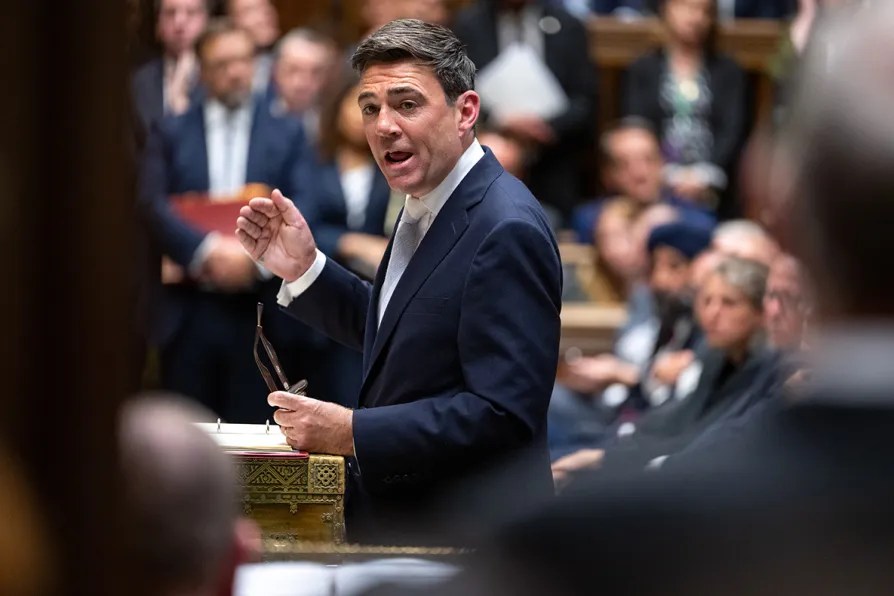
Andy Burnham’s first appearance in the Commons as Prime Minister was meant to signal a change of direction. He walked out of Downing Street with the air of a man ready to confront the country’s long‑ignored structural problems — water, energy, transport — the basic machinery of daily life that has been left to rot under decades of ideological neglect. But when he finally stood at the despatch box, the debate that followed between Burnham and Kemi Badenoch revealed something more fundamental: Britain is still talking about symptoms while ignoring the disease.

You cannot separate the cost‑of‑living crisis from foreign policy. Westminster tries, of course. It always tries. But the world has grown too small, too volatile, too interconnected for that old trick to work. The shockwaves of war travel faster than any ministerial briefing, and Britain is standing directly in their path.
The Borrowing Spiral No One Wants to Explain
Badenoch’s claim that Britain’s soaring debt‑servicing costs — the highest in nearly three decades — stem from market fears of a “spendthrift Labour prime minister” is political theatre. Burnham’s counter‑argument, that the turbulence is simply the delayed consequence of Tory mismanagement, is equally inadequate. Both explanations are tidy, domestic, and conveniently self‑contained. Neither touches the real source of the shock.
Borrowing costs are rising everywhere: the United States, Japan, Germany — all facing historic highs. When multiple advanced economies experience the same spike, the cause is not a single government’s fiscal stance. It is structural. It is global. And it is violent.
Energy prices — the foundation stone of every modern economy — have surged because one of the world’s most important trade routes has been choked by war. The US‑Israeli assault on Iran has turned the Strait of Hormuz into a pressure point for the entire global system. When tankers slow, everything slows. When oil jumps, everything jumps. Inflation is not an abstract number; it is the bill for conflict.
Britain’s borrowing costs are rising because Britain is tied to a White House that has chosen escalation over diplomacy, bombardment over restraint, and spectacle over strategy. And Burnham, for all his talk of a “cost‑of‑living government,” has not broken that tie.
The Price of War, Paid at Home — Including Ukraine
The Iran conflict is not the only war draining Britain’s finances. Our support for Ukraine — politically justified, strategically muddled, financially opaque — has quietly become one of the largest unexamined expenditures in modern British history. Military aid, logistical support, intelligence cooperation, refugee resettlement, sanctions enforcement: each carries a cost, and together they form a bill that no minister has been willing to present honestly.
The Treasury’s own internal estimates (rarely discussed publicly) suggest that Britain’s total Ukraine‑related commitments — direct and indirect — now exceed £12–15 billion. That figure does not include the secondary effects: higher energy prices, disrupted supply chains, and the inflationary pressure created by Europe’s scramble for alternative fuel sources. Add those in, and the cost rises sharply.
Combine Ukraine with the Iran conflict, and the Centre for Economics and Business Research’s estimate — £2,400 per household by the end of next year — begins to look conservative. Burnham’s VAT tweaks and bus fare caps are not even in the same universe.
Armed Neutrality: A Way Out of Permanent Crisis
Britain cannot continue to behave as if every conflict on the planet requires our direct involvement. The country is exhausted — financially, militarily, socially. The old model of automatic alignment with Washington has become untenable. It is time to consider a position that once seemed unthinkable: armed neutrality.
Not pacifism. Not isolation. Neutrality backed by strength — a defensive posture that protects Britain’s territory, its trade routes, and its citizens, without dragging the country into every geopolitical drama engineered elsewhere.
Armed neutrality would allow Britain to:
- reduce military expenditure tied to foreign adventures
- redirect resources toward domestic resilience
- rebuild diplomatic credibility as an independent actor
- lower borrowing costs by reducing war‑driven inflation
- avoid entanglement in conflicts where Britain has no strategic interest
It would also force Westminster to confront a truth it has avoided for decades: Britain’s security depends more on energy independence than on military alliances.
Energy Self‑Sufficiency: The Only Real Shield
The closure of the Strait of Hormuz exposes a deeper weakness: Britain’s ongoing dependence on fossil fuels extracted in unstable regions and shipped across contested waters. Every crisis in the Gulf becomes a crisis in British supermarkets, British factories, British homes.
Energy self‑sufficiency is not a slogan. It is the only way to insulate Britain from the inflationary shocks that have become the defining feature of the 21st century. That means:
- accelerating domestic renewable capacity
- building strategic energy reserves
- investing in grid modernisation
- reducing dependence on imported gas
- rejecting US pressure to expand North Sea drilling
- regulating the AI‑driven data‑centre boom that devours electricity
A climate‑conscious government cannot remain aligned with a White House committed to setting the world on fire — literally and politically.
New Revenue Streams: Regulating What Already Exists
Britain’s fiscal debate is trapped in a narrow corridor: raise taxes, cut spending, or borrow more. But there are entire sectors of the economy operating in the shadows — unregulated, untaxed, and often unsafe — that could provide significant new revenue streams if brought into the light.
Prostitution Regulating and taxing sex work would:
- generate substantial revenue
- improve safety for workers
- reduce exploitation
- cut policing and court costs
- allow health services to operate openly and effectively
Countries that have adopted regulated models have seen both fiscal and social benefits. Britain’s refusal to follow suit is ideological, not practical.
Cannabis Legalising and taxing cannabis would:
- create a new multi‑billion‑pound industry
- reduce criminal justice expenditure
- undermine organised crime
- provide controlled access for medical use
- generate predictable, long‑term tax income
The economic case is overwhelming. The social case is stronger still.
The Prison System: A Monument to Waste
Britain’s prisons are overcrowded, expensive, and ineffective. Reform is desperately needed — not political point‑scoring. The country spends billions incarcerating non‑violent offenders who pose no threat to the public. The result is a system that punishes poverty, mental illness, and addiction while draining public finances.
Moving away from prisons for non‑violent offenders would:
- save billions annually
- reduce reoffending
- allow investment in community‑based solutions
- free resources for early intervention
- treat social problems as social problems, not criminal ones
Early prevention — stable housing, mental‑health support, addiction treatment, youth services — costs a fraction of imprisonment and produces far better outcomes.
The Political Settlement That Cannot Survive This Moment
Burnham speaks often of rejecting the Thatcherite consensus. Yet he has not rejected the assumptions that underpin it: market primacy, geopolitical obedience, and the belief that Britain’s role is to follow rather than lead.
There is no path through this crisis that preserves both the old economic order and the old foreign‑policy order. Britain cannot cling to the US alliance as it currently exists and hope to escape the consequences of war‑driven inflation, energy volatility and global market turbulence.
The country needs a government willing to confront the real causes of its hardship — not just the symptoms. That means facing the cost of war, the cost of dependence, and the cost of silence. It means breaking with a foreign‑policy tradition that has left Britain economically exposed and strategically timid. It means treating energy policy as economic policy, and economic policy as foreign policy.
Above all, it means recognising that the current cost‑of‑living crisis is not a domestic accident. It is the predictable outcome of choices made far beyond Britain’s borders — choices that the British establishment has endorsed, enabled, and absorbed.
Burnham promised a new chapter. He will not deliver one until he stops writing in the margins of someone else’s book.
Discussion
No comments yet.